
Utah Dog Bite Report: What 12 Cases (and My Own) Taught Us
Utah Dog Bite Report · 2026
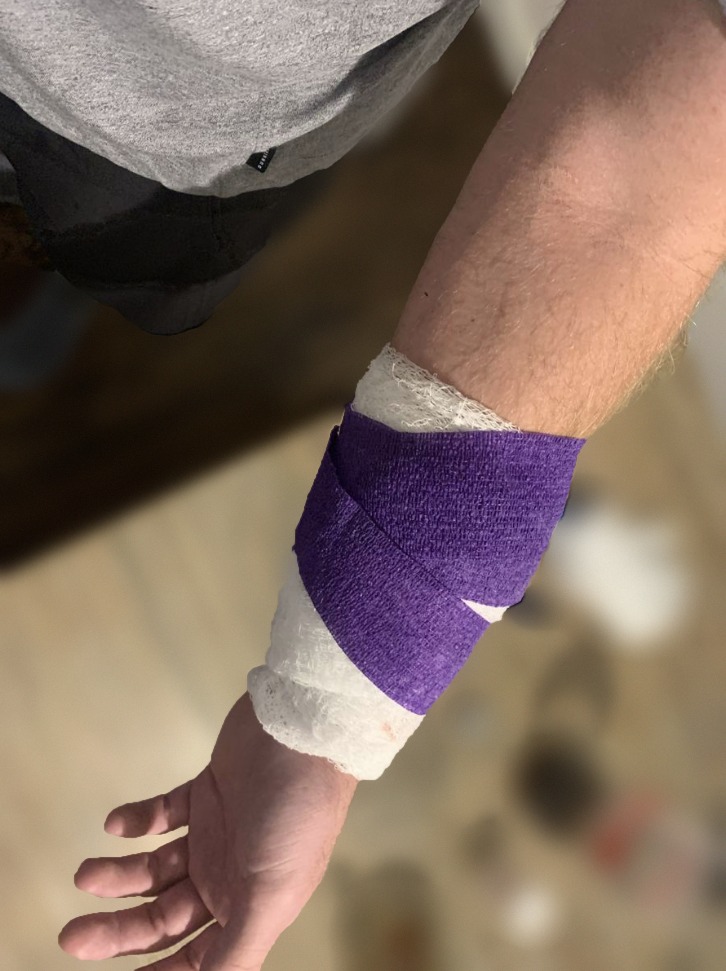
In July 2020 a dog bit me twice on the forearm while I stood in a stranger's front yard. I'm a personal injury lawyer, and I learned more about dog bite claims from that afternoon than from any case I've handled since. This report puts my own case next to eleven Utah dog bite cases our firm has handled, plus the best public data we could find, so you can see how these claims actually play out.
The short version
- Utah makes a dog's owner or keeper liable for injuries the dog causes, whether or not it ever bit anyone before (Utah Code § 18-1-1).
- Half the bites in our files came from a dog the victim already knew, and the worst injuries were to children's faces.
- The claim is usually paid by the owner's homeowner's or renter's insurance. With no coverage, even a strong case can end at $0. Mine did: the owner had insurance, but his policy excluded pit bulls.
- You generally have four years to file suit in Utah, but evidence disappears much faster. Report the bite within 24 hours.
The dog that bit me had bitten three people before
I was a young lawyer running documents to be notarized for my employer. I opened the gate of a fenced yard in Layton and knocked. Four dogs came out through a dog door: three chihuahuas and a black pit bull. The pit bull jumped on me but didn't bite, then wandered into the yard. A woman answered, told me the person I needed wasn't there, and shut the door.
As I walked back toward the gate, the pit bull ran at me and grabbed my left forearm through my dress shirt. I got it off. It bit me again in the same spot, harder. I screamed, it let go, and I jumped the chain-link fence and got into my car.
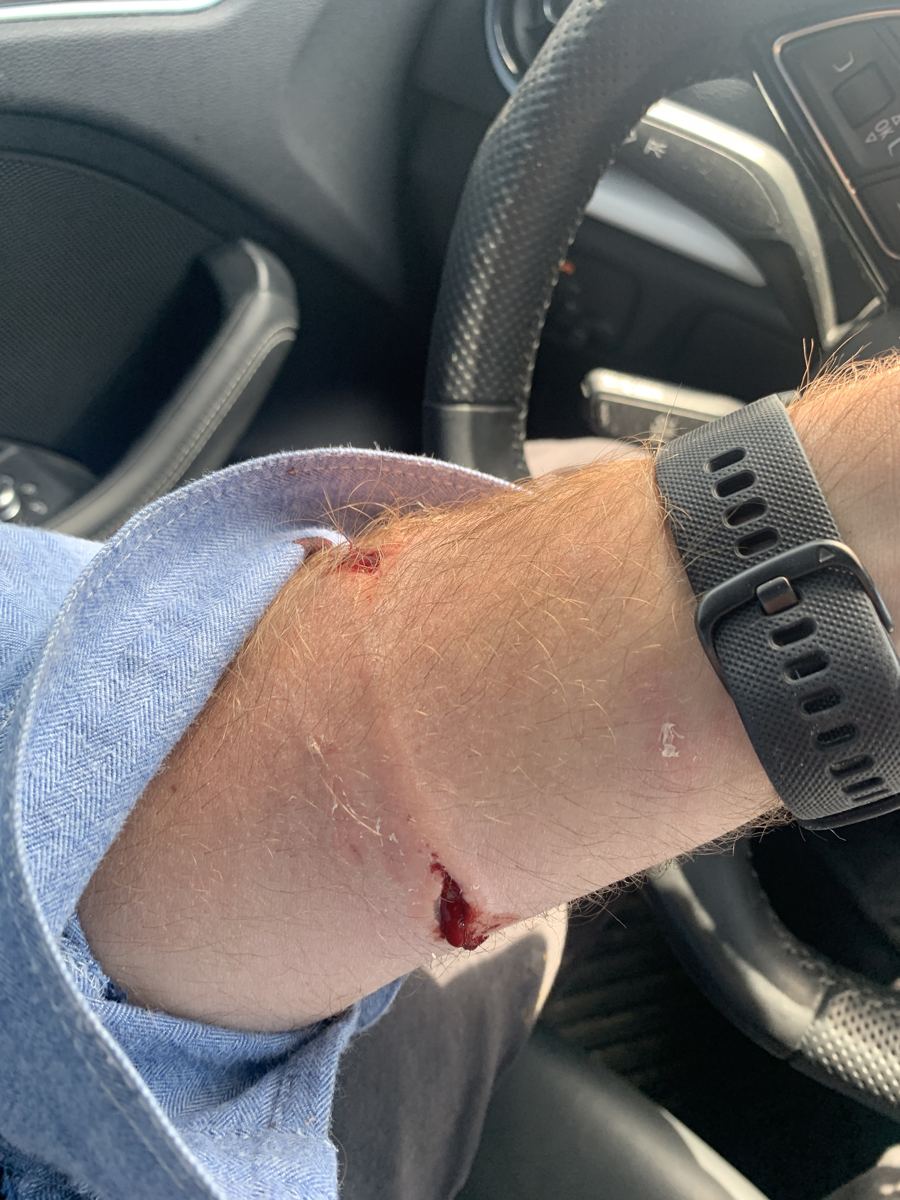
I drove to the nearest InstaCare. The staff took one look at how pale I was and wheeled me to the emergency room, worried I'd faint. I left with stitches, antibiotics, and three puncture wounds.
Graphic photo: the wounds in the ER (tap to view)
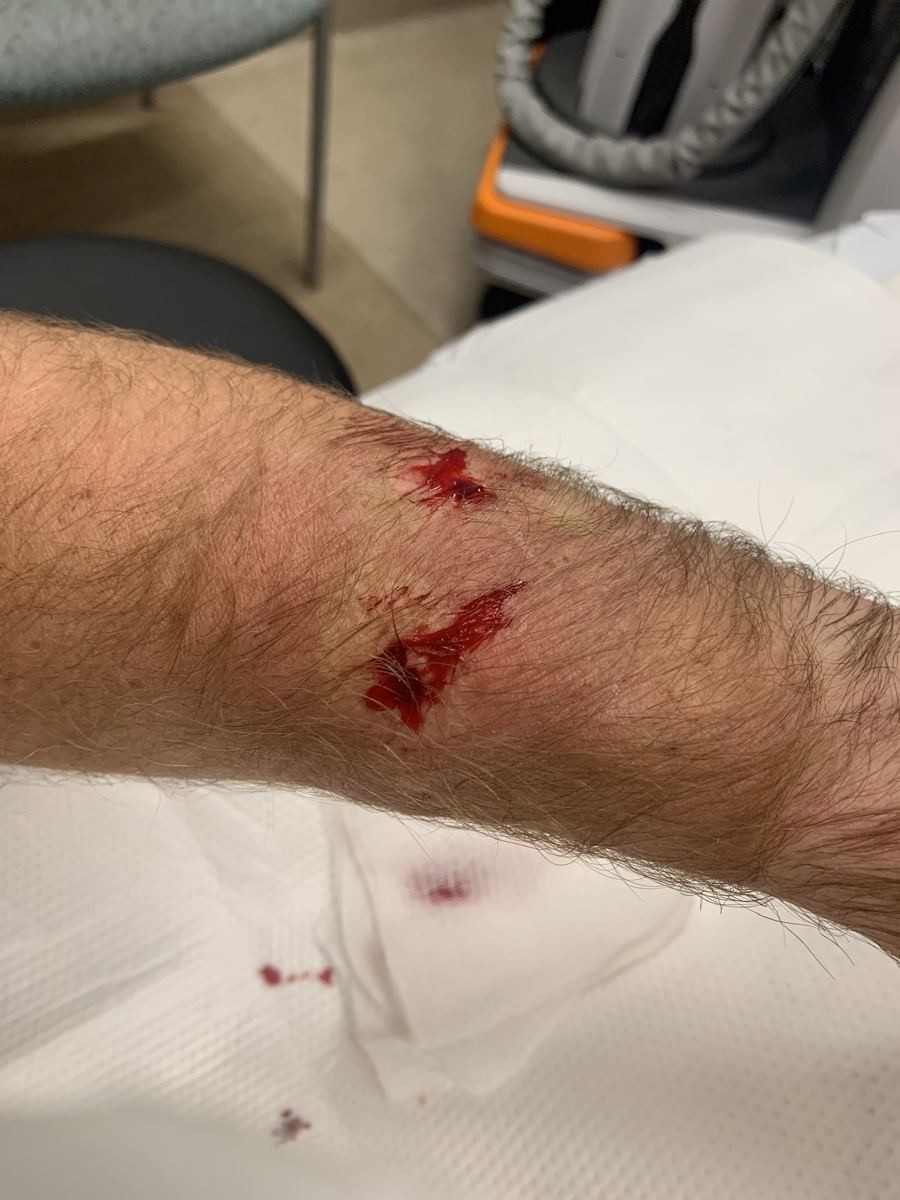
Animal Care of Davis County rated the bite a severity 3, unprovoked, and noted the dog's rabies vaccination had lapsed more than a year earlier. Then I filed a records request for the dog's history. The county sent back three earlier bite reports on the same dog:
| Date | Who was bitten | What the county recorded |
|---|---|---|
| Feb. 2016 | A young boy | Playing basketball in the street. The dog came under the fence and bit his arm and buttock. An older friend had to kick it off. Severity: severe. |
| June 2017 | An adult | Bitten on the forearm. A 4-inch bruise and a 5½-inch abrasion. Unprovoked. |
| Apr. 2018 | An adult | Bitten on the arm in the dog's yard. Minor. The owner said the man slapped the dog. |
| July 2020 | Me | Two bites, three punctures to the forearm. Severity 3. Unprovoked. Rabies shots lapsed. |
Every one of those bites was reported. The dog was quarantined at the shelter twice. Four years after it attacked a child in the street, it was still getting out through a dog door.
The aftermath was harder than the wound. For the next ten months I kept a journal: nightmares, crossing the street to avoid dogs, carrying pepper spray on every walk, and the night a neighbor's husky picked up my own small dog and shook her. I started trauma therapy.
I asked the owner for his homeowner's insurance information, then sent a formal demand by certified mail. The Postal Service couldn't deliver it. The reason it gave was "animal interference." The owner did have homeowner's insurance, but the policy had a specific exclusion for pit bulls. I sued him in March 2021. He filed bankruptcy, and the case was dismissed. I recovered nothing.
That's the lesson I carry into every dog bite case now: liability is the easy part in Utah. Finding the money is the hard part.
What twelve Utah dog bite cases taught us
We went back through every closed dog bite file in our archive. After setting aside a misfiled car accident, an out-of-state case, and a dog knockdown with no bite, we had twelve Utah bites, including mine. That's not a scientific sample, and we're not presenting percentages as if it were. But the same patterns showed up again and again.
1. Half the victims knew the dog or its owner
Six of the twelve were bitten by a dog belonging to a neighbor, a friend, a roommate, or the owner of a building they managed. Two more, including me, were bitten at the owner's home while there on business. Only three were bitten by a stranger's dog, and one file doesn't say. Five bites happened at the owner's home or yard. That matches national research: most bites come from a familiar dog, often at home.
2. Children took the worst injuries
Three victims were children, ages 6, 7 and 10. All three were bitten on the face or body, not the hands or legs. Two had facial wounds that needed stitches, one under sedation. A child's facial scar was also the single biggest driver of value in our files.
3. "He's never bitten anyone" doesn't matter in Utah
In four of our cases the owner or the animal control record said the dog had never bitten anyone. Under Utah's strict liability statute, that doesn't change the owner's responsibility. The law asks whether the dog caused the injury, not whether the owner saw it coming.
4. Insurance decides almost everything
Every settlement in our files was paid by an insurance policy, usually the owner's homeowner's policy. In my own case the owner had a policy, but it excluded pit bulls, so it didn't cover the dog that bit me. Same law, same kind of injury: a very different result.
5. The injury isn't only physical
Half of our clients went to counseling afterward for anxiety, nightmares, or fear of dogs. One client was never treated for the bite at all; her claim was entirely about the anxiety that followed, and it still settled.
6. Late reports make cases harder
Some bites in our files were reported to animal control days or even months later, often only after a lawyer asked. A late report means no quarantine record, no officer's notes from the day of the bite, and an easier argument for the insurer that the story changed.
7. Most claims settled within a year, without a lawsuit
The cases that settled took between three and twelve months from the bite, about ten months at the median, and none required filing suit.
What those cases recovered
Here is every recovery in a closed Utah dog bite file we reviewed, described without identifying the client:
| Client | Injury | Medical bills | Recovery |
|---|---|---|---|
| Man, 68 | Bitten on the wrist and forearm by two dogs and knocked to the ground. The fall tore his rotator cuff, which needed surgery. | About $110,700 | $300,000 |
| Boy, 6 | Bitten on the upper lip by a friend's dog. Four stitches, an infection, and a scar a plastic surgeon expects to revise when he's older. | About $6,100 (including future scar care) | $185,000 |
| Boy, 10 | Bitten on the side by a neighbor's dog near a park. ER, antibiotics, trauma counseling. | About $2,700 | $27,500 |
| Man, 62 | Bitten on both hands while pulling a loose dog off his own dog. | About $2,400 | $22,500 |
| Woman | Bitten on the wrist at work. No medical treatment; counseling for anxiety. | About $4,250 (counseling) | $6,500 |
| Me | Two bites to the forearm, stitches, therapy. Owner's policy excluded pit bulls; he filed bankruptcy. | About $12,500 (all economic losses) | $0 |
Every case is different. Past results do not guarantee a similar outcome, and these figures are gross recoveries before fees and costs.
One more from our files shows how broad Utah's statute is. A man on a skateboard was chased by a small off-leash dog in a park, fell, and broke his arm. The dog never touched him. The owner's insurer still paid $67,500, because Utah's law covers "an injury caused by the dog," not only bites.
How bad was the bite? The Dunbar scale
Animal control officers, trainers and insurers often describe bites using a six-level scale created by veterinarian and behaviorist Dr. Ian Dunbar:
| Level | What it means |
|---|---|
| 1 | Aggressive behavior, but no tooth contact with skin. |
| 2 | Teeth touch skin, but no punctures. Maybe nicks or slight bleeding. |
| 3 | One to four shallow punctures from a single bite. |
| 4 | At least one puncture deeper than half the length of the dog's canine tooth, or deep bruising or tearing from the dog holding on and shaking. |
| 5 | Multiple Level 4 bites, or repeated attacks. |
| 6 | The victim dies. |
Dunbar's own guidance is that Levels 1 and 2 make up the overwhelming majority of dog incidents, and that a dog that bites at Level 4 is dangerous and likely to bite again. In our files, most bites we could score from the medical records were Level 3, and three looked like Level 4. Those were the deepest wounds in our files, including two bites to the face.
The scale matters for your claim because it gives an insurer, and a jury, an objective way to understand a wound. Photos, an ER description, and an animal control report that records the bite level make that much easier to prove.
Dog bites in Utah: the numbers
- About 8,000 people in Utah went to an emergency room for dog bites from 2016 to 2021, roughly 1,300 a year, according to the Utah Department of Health and Human Services as reported by the Salt Lake Tribune. Fewer than 200 were admitted to the hospital.
- In West Valley City, the 2024 ER rate for non-venomous bites and stings (a state category that includes dog, cat and other animal bites) was 22.3 per 10,000 residents, about 44% higher than Utah's overall rate of 15.5, according to Utah's public health database (IBIS). West Jordan's was 16.6.
- Nationally, dog bite insurance claims hit a record 28,450 in 2025, with an average cost of $65,450 per claim, according to the Insurance Information Institute and State Farm.
- The CDC estimates that nearly one in five people bitten by a dog needs medical care, and that children are more likely than adults to be bitten.
- Salt Lake County Animal Services logged 665 animal bite calls and 529 vicious dog calls in 2018, the latest year it published, and those numbers don't include cities like West Valley and West Jordan that run their own animal services.
Utah dog bite law in plain English
Strict liability
Utah Code § 18-1-1 says an individual who owns or keeps a dog is liable for an injury the dog causes, regardless of whether the dog is vicious or the owner knew it was. Utah has no "one free bite" rule. The statute was reworded in 2025 and now lists two exceptions: certified police dogs, and trespassers injured while the dog is secured in a fence or enclosure on the owner's property.
Comparative fault
The owner can still argue you were partly at fault, for example by provoking the dog. Under Utah's comparative negligence law, your recovery is reduced by your share of fault, and you can't recover if your fault is equal to or greater than the owner's.
Owners and keepers
The statute covers anyone who "owns or keeps" a dog. That can include a person caring for the dog, not just the person who bought it. When a landlord or another household member is involved, who counts as a keeper is often the central question.
The new arbitration option
Since May 6, 2026, Utah Code § 18-1-4 lets a person injured in a dog attack who has already filed suit choose arbitration instead, by filing a notice within 14 days after the defendant answers. The award is capped at $50,000 (not counting property damage), can be collected only from available insurance rather than the owner's personal assets, and can't include punitive damages. Either side can ask for a new trial within 20 days of the award, but faces a cost penalty if the result doesn't improve enough. It can be a faster route for smaller claims, but it limits what you can recover, so get advice before electing it.
Deadline to file
You generally have four years from the date of the bite to file a lawsuit in Utah. A bite involving a government-owned dog or property follows the much shorter Governmental Immunity Act notice rules, so act quickly in that situation.
Quarantine and reporting
Under Utah's rabies rule, any dog that bites a person must be quarantined for ten days, whether or not it's vaccinated. West Valley City's code requires both the dog's owner and the person bitten to report the bite to animal control or the health department within 24 hours, and doctors who treat the bite must report it too.
Why a dog bite judgment can be worth nothing
When there is no insurance, or the policy excludes the dog, the claim is against the owner personally. If the owner files bankruptcy, a dog bite debt is usually discharged with everything else. Federal bankruptcy law makes an exception for "willful and malicious injury," but the U.S. Supreme Court held in Kawaauhau v. Geiger (1998) that negligent or even reckless conduct isn't enough. Letting a dog with a bite history run loose is negligence, not malice. That's exactly how my case ended.
So the first thing we do in a dog bite case is find the policy: the owner's homeowner's or renter's insurance, a landlord's policy, an umbrella policy, or a business policy if the bite happened at work. Your own health insurance may cover your medical bills, but it won't compensate you for pain, scarring, or lost time.
How to find out if a dog has bitten before
Bite reports held by animal control are government records, and you can request them under Utah's Government Records Access and Management Act (GRAMA). That's how I learned about the three earlier bites.
- Where to send it: the agency that handles animal control where the dog lives. West Valley City requests go through the City Recorder's online records portal. West Jordan's animal services is part of its police department, so use the police records request portal. Areas served by Salt Lake County Animal Services go through the county's GRAMA process.
- What to ask for: prior bite reports, dangerous or vicious dog designations, quarantine and impound records, and citations. Include the dog owner's address and, if you have it, the bite report or case number.
- How long it takes: agencies generally have 10 business days to respond. Some personal information, like home addresses and phone numbers, may be redacted.
What to do after a dog bite in Utah
- Get medical care. Dog bites infect easily, and many need antibiotics even when they look minor.
- Photograph everything. The wound right away and as it heals, your torn clothing, the dog, and the place it happened.
- Report the bite within 24 hours to animal control or the police. Ask for the report number.
- Get the owner's name and insurance. Ask for their homeowner's or renter's insurance carrier and policy number.
- Write things down. Keep a simple journal of pain, sleep, missed work, and fear. It becomes evidence.
- Request the dog's bite history through GRAMA, or let a lawyer do it.
- Talk to a lawyer before giving a recorded statement to the owner's insurer.
If you or your child was bitten anywhere in Utah, including West Valley City, West Jordan or Salt Lake City, call us for a free consultation. We'll start by finding the insurance. There are no attorney fees unless we win.
Frequently asked questions
Is a dog owner always liable for a bite in Utah?
Almost always. Utah's strict liability statute makes the owner or keeper liable even for a first bite. The exceptions are certified police dogs and trespassers injured while the dog was secured in a fence or enclosure, and your recovery can be reduced if you were partly at fault.
How long do I have to file a dog bite claim in Utah?
Generally four years from the date of the bite to file a lawsuit. Claims involving a government entity have much shorter notice deadlines.
Who pays for a dog bite in Utah?
Usually the dog owner's homeowner's or renter's insurance. If there's no insurance, you would have to collect from the owner personally, which may not be possible.
Can I get compensation for anxiety or fear of dogs after a bite?
Yes. Emotional distress, including anxiety, nightmares and PTSD symptoms, is part of the damages in a Utah dog bite claim. Counseling records help prove it.
How much is a dog bite claim worth in Utah?
It depends on the injury, scarring, the victim's age and the insurance available. In our files, recoveries ranged from $6,500 for a bite treated with counseling only to $300,000 for a bite and fall that required shoulder surgery.
How do I find out whether a dog has bitten someone before?
Submit a GRAMA records request to the animal control agency where the dog lives, asking for prior bite reports, dangerous dog designations, and quarantine records.
Since this report was published: Utah added a trespasser exception to the dog bite statute in 2025, and the arbitration track for these cases was reworked in 2026. Both are covered in what actually changed in Utah dog bite law in 2025 and 2026.
Sources: Utah Code §§ 18-1-1, 18-1-4, 78B-2-307, 78B-5-818 and 63G-2-204; Utah Admin. Code R386-702-14; West Valley City Code § 23-4-101; Utah DHHS via the Salt Lake Tribune (Nov. 24, 2023); Utah IBIS-PH ED encounter data, 2024; Insurance Information Institute, "Dog-related injury claims on the rise in 2025" (Apr. 2026); CDC, "Dogs" (2026); Salt Lake County Animal Services 2018 Annual Report; Dr. Ian Dunbar's Dog Bite Scale (Association of Professional Dog Trainers); Kawaauhau v. Geiger, 523 U.S. 57 (1998); Animal Care of Davis County bite reports B16-002391, B17-003578, B18-004313 and B20-006082. Firm case data reflects closed West Injury Law dog bite files reviewed in October 2026.